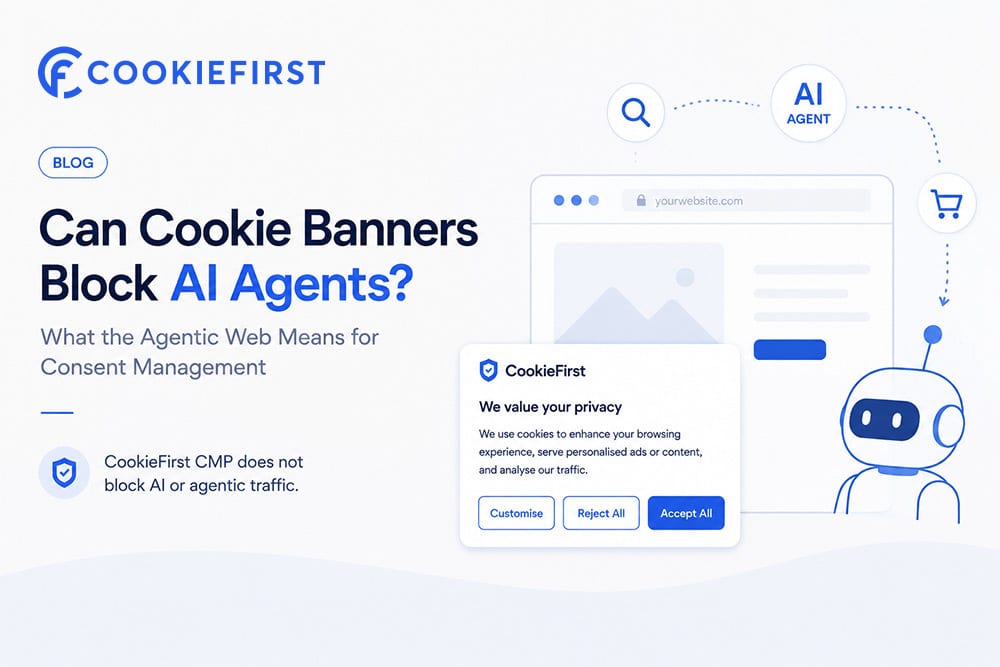
Can Cookie Banners Block AI Agents? What the Agentic Web Means for Consent Management
AI isn’t just reading the web anymore. Increasingly, it’s using it.
AI agents can search for products, compare prices, navigate websites, fill in forms and potentially
complete transactions on someone’s behalf. That changes something website owners haven’t had to
think much about until now: what happens when an AI agent encounters a cookie banner?
The answer is surprisingly important.
A poorly implemented consent layer can interfere with automated browsers and AI agents. In some
cases, it can make a website difficult or impossible for an agent to use.
But that doesn’t mean cookie consent and the agentic web are incompatible. They shouldn’t be.
At CookieFirst, our CMP does not block AI or agentic traffic. Here’s why that distinction matters.
AI traffic isn’t all the same
When people talk about “AI traffic”, they’re often grouping several very different things together.
An AI crawler might request the HTML of a page to discover or index its content. An AI search engine
might retrieve a page because it needs information to answer a user’s question. A browser-based AI
agent, meanwhile, may actually interact with the website.
That last category creates a new challenge.
Imagine asking an AI assistant:
“Find me a pair of running shoes under €150 that can be delivered by Friday.”
An agent might search several stores, open product pages, compare options and potentially add a
product to a shopping cart.
Now put a consent banner in front of it.
If the implementation effectively locks the website until the visitor interacts with the banner, the agent first has another problem to solve.
It needs to understand the consent interface.
Can a cookie banner block an AI agent?
Potentially, yes.
The visible banner itself isn’t necessarily the problem. What matters is how the consent mechanism
has been implemented.
Some websites use full-screen overlays. Others prevent interaction with the underlying page until a consent choice has been made. Scripts may be prevented from loading until consent is received. Occasionally, website functionality that should be considered necessary is incorrectly placed behind consent.
For a human visitor, this is usually an inconvenience at worst. You click “Accept”, “Reject” or configure your preferences and continue.
An automated agent may behave differently.
If it can’t identify the consent interface, can’t interact with the controls or can’t access functionality required for its task, the journey can stop there.
That becomes much more significant as agents move from simply reading websites to doing things on websites.
Crawlers and agents are different
There’s another important distinction.
Many AI crawlers don’t interact with websites the way humans do. They request pages programmatically and may not execute all the JavaScript that would run inside a normal browser session.
A JavaScript consent banner therefore doesn’t automatically make a website invisible to AI crawlers.
Browser-based agents are different.
They may render pages, click buttons, open menus and interact with interfaces much more like a normal visitor. These agents are far more likely to encounter the consent experience itself. So asking whether “cookie banners block AI” is slightly too broad.
A better question is:
Does your consent implementation interfere with the way an AI system needs to access or interact with your website?
Cookie Consent Manager | Take a 2 week free trial
Take a 2 week free trial for our paid plans or create a free account …
CookieFirst does not block AI or agentic traffic
This is an important distinction in how CookieFirst approaches consent management.
CookieFirst does not block AI traffic or agentic traffic from accessing your website.
The purpose of a CMP is to manage consent and control technologies that require consent. It isn’t supposed to turn the consent layer into a gatekeeper for the website itself.
For example, analytics or advertising technologies may need to remain inactive until the appropriate consent has been obtained. Essential website functionality is a different matter.
That separation becomes increasingly important in an agentic web.
A visitor, whether human or automated, should be able to access the website and its essential functionality without being forced to consent to unnecessary tracking.
Necessary functionality really needs to be necessary
The arrival of AI agents also highlights an old CMP implementation problem.
Website owners sometimes classify scripts incorrectly.
A script that’s genuinely required for a shopping cart, authentication process or another essential service shouldn’t suddenly become unavailable simply because a visitor rejected analytics or advertising cookies.
That already matters for human visitors.
It matters even more when software is navigating the website on their behalf.
Consider an E-commerce agent trying to complete this journey:
Search → product page → product selection → cart → checkout
If an analytics script doesn’t load because consent hasn’t been provided, that’s expected.
If the cart doesn’t work because a required script has accidentally been placed in the same consent category, that’s a problem.
The rise of agents gives website owners another reason to review exactly what their consent
implementation is blocking.
Should websites automatically bypass consent for AI agents?
Probably not.
It’s tempting to solve agent compatibility by detecting bots or AI agents and simply removing the consent layer for them.
But that introduces another question: who is the agent acting for?
An AI crawler indexing public information is one thing.
An AI agent acting directly on behalf of a person is something else.
If an agent visits a website, searches for a product and completes a transaction for its user, automatically treating that interaction as outside privacy and consent requirements would be a questionable assumption.
Agent detection isn’t a substitute for proper consent architecture.
The better approach is to make sure the website works without unnecessary tracking in the first place.
The web is becoming machine-readable and machine-usable
SEO has traditionally been about making websites understandable to search engines.
AEO and GEO have expanded that conversation toward making information understandable and discoverable by AI systems.
Agentic browsing adds another layer:
Can AI actually use your website?
That’s a different requirement.
Structured content helps an AI understand what a product costs. Clear HTML helps it identify a button. Accessible interfaces can make actions easier to interpret. Predictable navigation helps it move around.
Consent interfaces are now part of that equation too.
A website can be perfectly indexable and still be difficult for an AI agent to operate.
Cookie Consent Manager | Take a 2 week free trial
CookieFirst’s automated approach provides significant value here as our Cookie banner detects GPC and Do Not Track signals automatically, it removes implementation complexity. When CookieFirst detects these signals, it immediately adjusts behavior to prevent tracking, ensuring your cookie banner requirements and consent mechanisms respect browser-level preferences without additional configuration.
Consent UX may need to evolve
This doesn’t mean cookie banners are going away.
It means CMPs and websites increasingly need to consider two types of visitors: humans and software acting on behalf of humans.
Good consent design already points in the right direction.
Consent choices should be clear. Rejecting optional tracking shouldn’t break essential functionality.
Necessary technologies should be properly classified. Websites shouldn’t depend on advertising or analytics consent just to perform their basic purpose.
Those principles make websites better for people. Conveniently, they also make them easier for agents.
A new website test: can an agent use it?
Website testing usually covers browsers, screen sizes, accessibility, performance and increasingly privacy.
It may soon include another question:
Can an AI agent successfully complete the important journeys on this website?
For an ecommerce store, that might mean finding a product and reaching checkout.
For a SaaS company, it might mean finding pricing, understanding the product and starting registration.
For a publisher, it might simply mean discovering and reading an article.
The consent layer should be part of those tests.
If rejecting optional cookies makes an essential journey impossible, that’s worth investigating regardless of whether the visitor is a person or an AI agent.
Privacy and the agentic web don’t have to conflict
There’s a tendency to frame privacy controls as friction.
The rise of AI agents could reinforce that idea. Remove the consent layer, and agents can navigate more easily.
But that’s the wrong conclusion.
The goal isn’t to remove privacy controls so machines can access websites. It’s to implement privacy controls in a way that doesn’t unnecessarily prevent access to the website itself.
CookieFirst does not block AI or agentic traffic. Technologies that require consent can still be controlled, while the website and its necessary functionality remain accessible.
As agents become a larger part of web traffic, that distinction is likely to matter more.
The next generation of websites won’t just be visited by people and crawled by search engines. They’ll increasingly be used by software acting for people. Consent management needs to work in that world too.
CookieFirst
Get consent before loading third party tracking scripts
Ready to ensure your website respects Global Privacy Control? CookieFirst’s advanced cookie consent management platform automatically detects and honors GPC and Do Not Track signals, keeping you compliant with evolving privacy regulations. Start your free trial today and join 60,000+ customers that prioritize user privacy while maintaining compliance across all major privacy laws.